R-Panel & Exposed-Fastener Metal Roofing in Georgetown
R-panel and corrugated roofing is the most affordable way to put metal over your building: typically $9 to $14 per square foot installed. Panels are screwed down through the face, which makes installation fast and cheap. The trade-off is those exposed fasteners: they're the part that needs attention down the road.
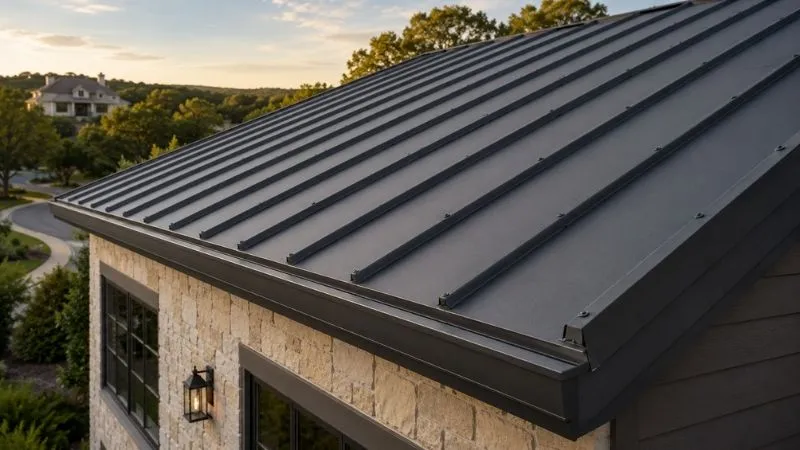
What is an exposed-fastener metal roof?
Exposed-fastener panels, meaning R-panel, PBR, corrugated, and similar profiles, are long metal sheets fastened directly through the surface into the deck or purlins below. You can see the rows of screws across the roof; that's the defining feature. Because installation is straightforward and material costs are low, it's the least expensive metal system available.
Where does it make the most sense?
- Barns, shops, and outbuildings: the classic use, and hard to beat on price
- Detached garages and covered porches
- Acreage north and west of Georgetown toward Andice, Walburg, Weir, Florence, and Jarrell, where the look fits the setting
- Budget-driven residential projects where metal is the goal but standing seam is out of reach
- Low-slope agricultural and light commercial buildings
Around Georgetown, the natural fit is the land outside the city limits. Head north or west past Serenada and the lots get bigger and the buildings get simpler: workshops, equipment barns, hay storage, hangar-style shops out toward the airport. Those are R-panel buildings. Putting standing seam on a hay barn is spending money in the wrong place.
One thing to check before you assume the rules do not apply to you: the City of Georgetown requires a permit for any new roof inside the city limits, and the city limits reach further than most people expect after a decade of annexation. The City has an address checker for exactly this question. If you are inside, it is a $60 permit and 10 to 15 business days, and your contractor has to be registered with the City first.
What profiles are available?
| Profile | Typical use |
|---|---|
| R-panel (PBR panel) | The Texas workhorse. Wide ribs, strong spans, common on homes, shops, and barns. |
| Corrugated | Classic wavy profile. Often chosen for a rustic or agricultural look. |
| U-panel | Similar to R-panel with a different rib spacing and profile. |
| Ag panel | Economy profile built for barns, sheds, and outbuildings. |
How does R-panel hold up to Georgetown wind?
This is where the honest answer matters more than the sales one. Exposed-fastener panels are held down by screws through the face of the panel, and every one of those screws is both an attachment point and a potential leak. In high wind, the failure mode is predictable: a washer that has gone hard in the sun lets the screw work loose, wind gets under the panel edge, and the panel peels.
Georgetown gives you a real example. On 19 May 2026, straight-line winds of 74 mph moved through, with 64 mph recorded at Georgetown Municipal Airport. Two miles east of Serenada, the National Weather Service logged metal roof panels torn from a service station canopy. Those events are why 111 wind reports sit in the record for this area alongside 104 hail reports.
None of that makes R-panel a bad choice on a barn or a shop. It makes fastener maintenance a real obligation rather than an optional one. Plan on having the screws checked and the washers replaced somewhere around the 10 to 15 year mark, and sooner on a west-facing slope that takes the afternoon sun. If the building is one you would be genuinely upset to lose the roof on, put the money into standing seam instead and skip the maintenance schedule.
The honest trade-off: exposed fasteners
We'd rather tell you this up front than have you discover it in year twelve. Every screw on an exposed-fastener roof passes through the weather surface, sealed by a small rubber washer. Those washers are the weak point. Texas heat, UV, and thermal cycling dry them out, and screws can loosen as panels expand and contract. Somewhere around 10 to 15 years, most of these roofs need fasteners inspected, tightened, or replaced.
That's a manageable maintenance item, not a defect, but it's the reason standing seam costs more. Standing seam hides its fasteners under the seams, so there's nothing penetrating the surface to fail. If you're roofing a house you plan to keep for decades, that difference usually justifies the higher price. Compare the costs here.
How much does it cost?
Expect roughly $9 to $14 per square foot installed in Central Texas. Simple rectangular roofs, meaning barns, shops, and garages, sit at the low end. Residential roofs with valleys, dormers, and complex flashing run higher. Tear-off of an existing roof adds to the total.
R-panel FAQs
How long does an exposed-fastener metal roof last?
How much does an R-panel roof cost in Georgetown?
Do exposed-fastener roofs leak?
Is R-panel a good choice for a house?
Ready for a straight answer on your roof?
Call for a free inspection. We'll take a look, walk you through your options, and there's no pressure either way.
Call (737) 320-3400